Jaipur is placed in a higher earthquake risk zone
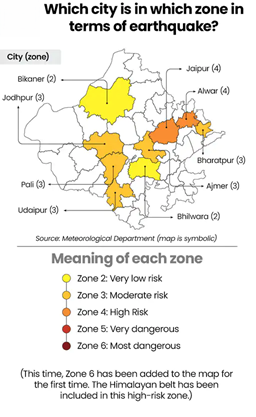
Jaipur is placed in a higher earthquake risk zone for the first time: Alwar and Bhiwadi are also in the red zone. A warning has been issued over the collapse of hundreds of old buildings
Jaipur has been placed in a high-risk earthquake zone, along with Alwar and Bhiwadi. Being classified as a high-risk zone means that earthquakes measuring 5 to 6 on the Richter scale may occur in these areas, which can cause serious damage, particularly to older buildings.
Recently, the Bureau of Indian Standards (BIS) released the country’s new earthquake risk map, under which Jaipur, Bhiwadi and Alwar have been placed in Zone 4, indicating a higher seismic risk. Earlier, until 2016, Jaipur was categorised under Zone 2, which was considered a mild damage risk zone. This special report explains what it means to be placed in a high-risk earthquake zone.
Why Jaipur, Bhiwadi and Alwar now in high-risk zones?
In the newly released map, the seismic zones of many cities across the country have been upgraded. Several areas that were earlier considered low-risk have now been reclassified as more sensitive. The BIS has prepared the new map using the Probabilistic Seismic Hazard Assessment (PSHA) model. This is a scientific method that estimates the likelihood and intensity of earthquakes based on multiple parameters.
Until 2016-
- Bikaner was in Zone 3
- Ajmer, Jaipur, Jodhpur and Udaipur were in Zone 2
Under the new assessment, Jaipur and several other cities have moved into higher-risk categories.
Extra caution needed in new construction
Structural engineer Sunil Goyal said that most old buildings were not designed to withstand earthquake tremors. With the revised classification, there is now a need to prepare afresh. At present, buildings are often declared safe or unsafe based on a single certificate. He said that agencies such as the Jaipur Development Authority (JDA) and other regulatory bodies should thoroughly examine the drawings and structural design files of all projects.
Architects must strictly follow approved structural systems in their planning. At the same time, flat buyers should also remain vigilant. He explained this with an example: just as safety features are prioritised over appearance while buying a car, structural safety should take precedence over aesthetics when purchasing a home.
A new map does not mean earthquake risk has suddenly increased
Geologist Professor Manoj Pandit clarified that the new map does not mean the danger has suddenly increased or that earthquakes are now more likely to occur. Instead, the map indicates-
- How strong an earthquake can occur in a particular region
- How potential damage and loss can be reduced when an earthquake happens
He explained that the old map was largely based on historical earthquake data, whereas the new map has been prepared using advanced scientific methods. In that sense, the updated code is focused on earthquake preparedness, not fear.
Jaipur now in the same zone as Delhi NCR
Professor HS Sharma said that Jaipur was earlier placed in Zone 2, but now Jaipur and Delhi NCR fall under the same seismic zone.
He added that earthquake intensity increases in Zone 4, making it essential to pay close attention to the structural design of buildings in the coming years. Proper planning can significantly reduce loss of life and property in the event of a major earthquake.
What is the new earthquake map?
The BIS has released the updated seismic zoning under IS 1893 (Part 1): 2025, which will come into effect from January 2025.
Under this code:
- Buildings, bridges, highways and large infrastructure projects across the country will be constructed according to the new earthquake-resistant norms
- The new map replaces the earlier 2002 seismic map
How reliable is the new map?
Experts describe this as the most scientific and accurate earthquake risk map prepared so far in India.
The assessment includes:
- GPS and satellite data
- Mapping of fault lines
- Earthquake history
- Millions of computer-based simulations
Seismic assessment techniques used in countries such as Japan and New Zealand have also been adopted in preparing the map.
Will the new rules save lives?
According to experts, adherence to the new regulations can reduce earthquake-related damage by 80–90%. New buildings constructed under the revised norms are expected to-
- Withstand strong tremors
- Avoid complete structural collapse
However, experts stress that retrofitting and upgrading old buildings is equally necessary to ensure overall safety.